Home Decor Vector Line Art Set
A Quiet, Confident Kind of Charm
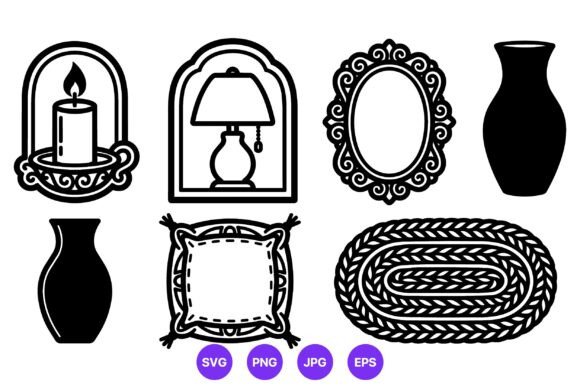
First glance at the Home Decor Vector Line Art Set feels like walking into a sunlit boutique—minimal, intentional, and full of quiet warmth. It’s not loud or trendy; it’s grounded. The lit candle in its holder, the table lamp with that subtle pull chain, the ornate oval mirror frame—all drawn with clean, confident strokes. No heavy shadows, no gradients, just pure black-and-white line art. That simplicity is its strength—and its first real test in embroidery.
How It Translates to Thread and Fabric
I recently sketched out a small-batch run of linen pillow covers for a local gift shop: neutral tones, hand-finished hems, and one central motif per cover. I chose the decorative pillow with tassels from the Home Decor Vector Line Art Set—not as literal inspiration, but as the *starting point* for an embroidered version. What stood out immediately was how naturally the lines translated to satin stitch outlines and delicate running-stitch accents. The curves held up beautifully on medium-weight linen, and the tassel details—though fine—stitched clearly without bleeding or distortion when paired with a lightweight cutaway stabilizer.
This set shines brightest on structured, low-texture surfaces: tea towels, cotton aprons, canvas tote bags, and baby onesies where softness matters. On a sweatshirt? Yes—but only if you’re using a dense, stable knit and adjusting stitch density downward. The line weight is consistent enough to avoid “ghosting” on thicker fabrics, yet fine enough to read cleanly at 3–4 inches wide. That makes it ideal for custom apparel where subtlety reads as sophistication—not afterthought.
Where It Fits (and Where It Doesn’t)
The Home Decor Vector Line Art Set isn’t built for chaos. It won’t hold up on stretchy jersey without significant digitizing tweaks. It’s not the right pick for curved cap fronts unless you simplify key elements first—the ornate mirror frame, for example, has tight inner scrolls that’ll fight tension on a small hoop. And while the two vases look elegant side-by-side in vector form, stitching them both full-size on a single baby bib? Too much visual weight. Choose one, scale it thoughtfully, and leave breathing room.
Dark fabric demands attention here. Since these are pure line art graphics—not filled illustrations—you’ll need high-contrast thread (white or cream on navy, charcoal on oatmeal) to preserve legibility. And always test on scrap first: what looks crisp on screen can blur slightly when stitched densely on textured weaves like burlap or looped terry.
Real Projects, Real Feedback
Last month, I used the table lamp motif on a set of holiday kitchen towels for an Etsy seller. Customers loved the “cozy but curated” vibe—several tagged us in Instagram posts styled with ceramic mugs and dried eucalyptus. Why? Because the design didn’t shout. It invited pause. That kind of emotional resonance is rare in generic embroidery files. It’s what turns a handmade product into a personalized gift people keep—not just display.
Conversely, I passed on using the candle motif for a line of embroidered patches meant for backpacks and denim jackets. Why? The flame detail is too delicate for high-wear applications. It’s better suited to nursery decor, framed embroidery hoops, or boutique baby blankets—places where care and context elevate the detail instead of eroding it.
What It Adds to Your Craft Business
As a designer who reviews hundreds of embroidery files a year, I can say this: the Home Decor Vector Line Art Set doesn’t try to be everything. It knows its lane—and that clarity builds trust. When your Etsy listing shows a clean, well-stitched pillow cover with that oval mirror frame centered just so, buyers instantly understand your aesthetic. No explanation needed. That consistency strengthens brand recognition across your shop, whether you’re selling digital embroidery files, finished goods, or printable mockups for other makers.
It also works quietly behind the scenes. Use the vase outlines as subtle border motifs on tea towel hems. Pull the lamp’s pull chain as a repeating accent on a custom apron pocket. Layer the candle silhouette behind monogrammed initials for wedding gifts. These aren’t standalone showstoppers—they’re thoughtful design assets that support your voice, not drown it out.
Practical Notes Before You Stitch
- Always test on scrap fabric matching your final project’s weight and texture—especially for baby embroidery or holiday embroidery where wash durability matters.
- Review stitch density in your embroidery software. Line art like this often benefits from slightly reduced density in longer runs to prevent puckering.
- Confirm hoop size compatibility. Some motifs—like the full mirror frame—may require a 5x7 hoop minimum for clean execution.
- Inspect small corners and junctions. Does the pull chain connect cleanly? Do tassel ends taper without fraying in stitch preview?
- Check contrast in black-and-white mockups. This set lives in monochrome—so make sure your thread colors honor that intention.
- Use appropriate stabilizer: lightweight cutaway for knits, tear-away for stable wovens, and fusible + tear-away for sheer or slippery fabrics.
- Verify licensing before selling finished products or reselling the digital embroidery file. As Illustrations and Graphics, usage rights vary—and commercial embroidery requires clear permissions.
In short: the Home Decor Vector Line Art Set is a quiet collaborator. It won’t fix weak execution, but it rewards thoughtful design choices. Whether you’re building a craft business, launching a small shop product, or stitching a heartfelt personalized gift—it gives you clean, cohesive, and commercially viable design assets. Just remember: even the most elegant line art needs the right fabric, stabilizer, and intention to become something truly finished.